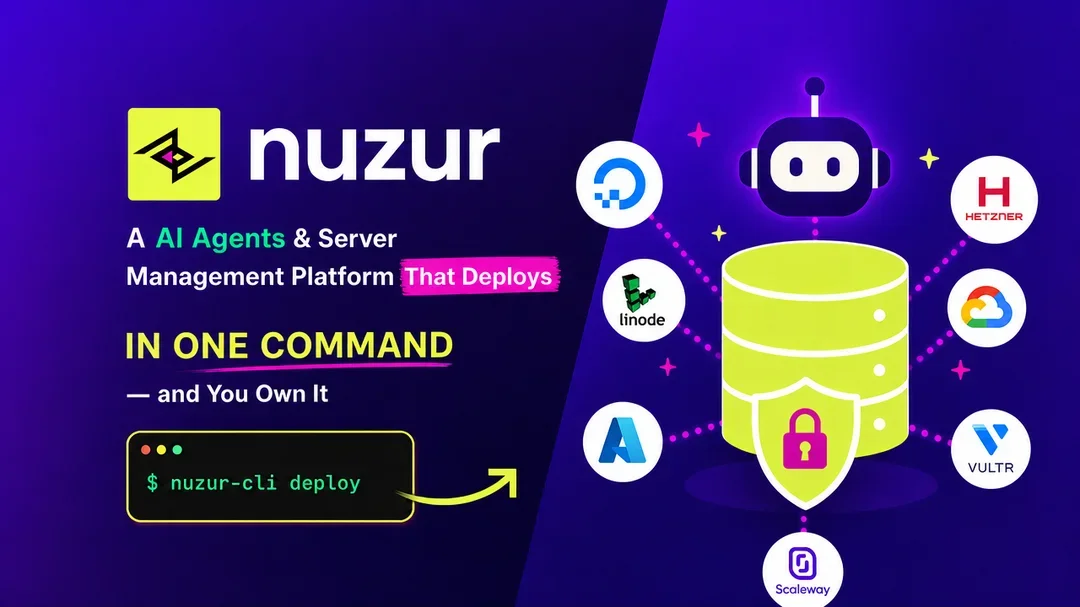
nuzur: A Supabase Alternative That Deploys in One Command — and You Own It
If you're searching for a Supabase alternative, you probably already know what Supabase does well — a hosted Postgres backend with auth, storage, and APIs, live in minutes. The question is usually why you're looking to switch. Most people land here for one of three reasons: the usage-based bill, the vendor lock-in, or the desire to run their own infrastructure.
For a long time the honest catch with owning your backend was speed: rolling your own meant writing migrations, an API layer, and deployment config by hand. nuzur removes that catch. You design your data model once, run a single command, and you have a live backend — on a server you own.
Why people look for a Supabase alternative
The common triggers:
- The bill scales with usage. Egress, compute, monthly active users, and per-project fees add up as you grow. A cheap prototype can become an expensive production app.
- Vendor lock-in. Your auth, data access, and deployment are shaped by the platform. Migrating off it later is real work.
- You want to self-host. Compliance, data residency, or principle — sometimes the backend simply needs to run on your infrastructure.
Most Supabase alternatives answer these by being "Supabase, but hosted somewhere else" or "Supabase, but self-hosted, and now you're the ops team." nuzur takes a different route.
One command to live — on your own server
With nuzur, your schema is the single source of truth. From that one visual model, nuzur-cli deploy does the whole thing in a single command:
nuzur-cli deploy --provider digitalocean --region nyc3 --project my-project --domain api.example.com
That command creates the server for you (DigitalOcean or Hetzner — or point it at a Linux box you already own), generates the Go application code, builds it on the box, provisions a database, applies your schema, and serves the API over HTTPS with an automatic Let's Encrypt certificate. When it finishes it prints your live URL.
The difference from Supabase is who owns the result:
- The server is yours. nuzur never receives your SSH key, database password, or cloud credentials — everything runs from your machine over your own SSH connection.
- The code is yours. The generated Go app lands in a directory you own and can edit, commit to git, and extend with custom REST or gRPC endpoints. Re-deploy keeps your edits.
- The database is yours. Self-hosted MySQL or Postgres on your box, or point it at a database you already run. It binds to localhost and is never exposed.
- The cost is yours to control. No platform fee, no egress meter, no per-project pricing — just the server you're paying for anyway.
Auth is built in too: pick JWT for a self-contained token setup, or wire up Keycloak. So are file uploads — enable file storage in the config and nuzur generates generic /upload and /sign endpoints, backed by S3 or Cloudflare R2, served by your own backend. The bucket credentials come from your team at deploy time or are provided directly, so nothing forces them through a middleman. You also get SQL migrations, a REST and/or gRPC API (pick REST, gRPC, or both), Helm charts for Kubernetes, and an MCP server so you and your team can manage data through Claude with a reviewed change-request workflow. The generation engine is open source (MIT), and nuzur is free for personal use.
What's driving your switch — and how nuzur answers it
Most people don't leave Supabase on a whim. They leave for one of the three reasons above, and each maps to something concrete nuzur does differently:
| Why you're leaving | Typical "alternative" | What nuzur does |
|---|---|---|
| The usage-based bill | Another host with its own meter | No platform fee or egress meter — you pay flat for a server you'd pay for anyway |
| Vendor lock-in | A new vendor to depend on | You own the Go code and the server; the generator is open source (MIT) |
| You want to self-host | Self-hosted Supabase — now you're the ops team | One command stands it up on your box; you own it without hand-building it |
That's the throughline: other alternatives relocate the rental. nuzur changes who owns the result — and makes owning as fast as renting.
For a full feature-by-feature breakdown against Supabase, see Supabase vs nuzur: Renting a Backend vs Owning One.
Is nuzur the right Supabase alternative for you?
Choose nuzur if:
- You're spinning up an MVP and want it live today — but on a foundation you own, so success doesn't mean a painful migration later.
- You want a real Go backend you own — not a runtime you rent.
- You can't accept a vendor in the critical path (compliance, data residency, or principle).
- You're optimizing for cost at scale — a flat infrastructure bill beats a usage-metered one.
- You want migrations, an API contract, and server code that stay in sync because they're all generated from one model.
Stick with Supabase if:
- You want realtime subscriptions — that's the one BaaS piece nuzur doesn't generate. (Auth and file uploads it does: the generated backend ships JWT/Keycloak auth and
/upload+/signendpoints backed by S3 or Cloudflare R2.) - Your team is frontend-heavy and wants instant client SDKs with zero backend to operate.
- You'd rather never touch a server, even a managed-for-you one.
nuzur doesn't try to replace the convenience of a BaaS feature-for-feature. It gives you the speed of one — from first MVP to production — with the ownership of a backend you built yourself.
FAQ
Is nuzur an open source Supabase alternative? The generation engine is open source (MIT), and it produces Go code you own outright. It's not a drop-in clone of the Supabase platform — it's a different model, where the backend is generated and deployed for you instead of hosted.
Is nuzur a self-hosted Supabase alternative? Yes, and without the usual catch. Self-hosting Supabase means running the whole platform yourself. With nuzur, one command stands up a Go backend on your own server (or one it provisions), so you get self-hosting without hand-building or operating a BaaS stack.
Do I have to deploy nuzur myself?
Not manually. nuzur-cli deploy handles the whole pipeline in one command and can even create the server for you. You own the result, but you don't assemble it by hand.
What's the best Supabase alternative for a Go backend? That's exactly nuzur's niche. Where most alternatives give you another platform runtime, nuzur generates idiomatic Go you can read, edit, and extend with custom REST or gRPC endpoints — deployed on Kubernetes-ready infrastructure you own.
Does nuzur include authentication and file storage like Supabase?
Auth, yes — built-in JWT, or Keycloak (OpenID). File uploads, yes — enable file storage and the generated backend exposes /upload and /sign endpoints backed by S3 or Cloudflare R2, with credentials resolved from your team at deploy or provided directly (the nuzur platform stores file-field files too). Realtime subscriptions are the one piece nuzur doesn't offer.
Is nuzur good for an MVP? Yes. One command gives you a live backend with auth, so you can validate an idea fast — the difference is that if the MVP takes off, you're already on a backend you own instead of one you'll need to migrate off later.
Getting started
nuzur is free for personal use. If you've been evaluating Supabase alternatives and what you actually want is to own the backend — not just move it to a different landlord — try generating one from a model and deploying it with a single command.
Most alternatives hand you a different place to rent. nuzur hands you the keys.